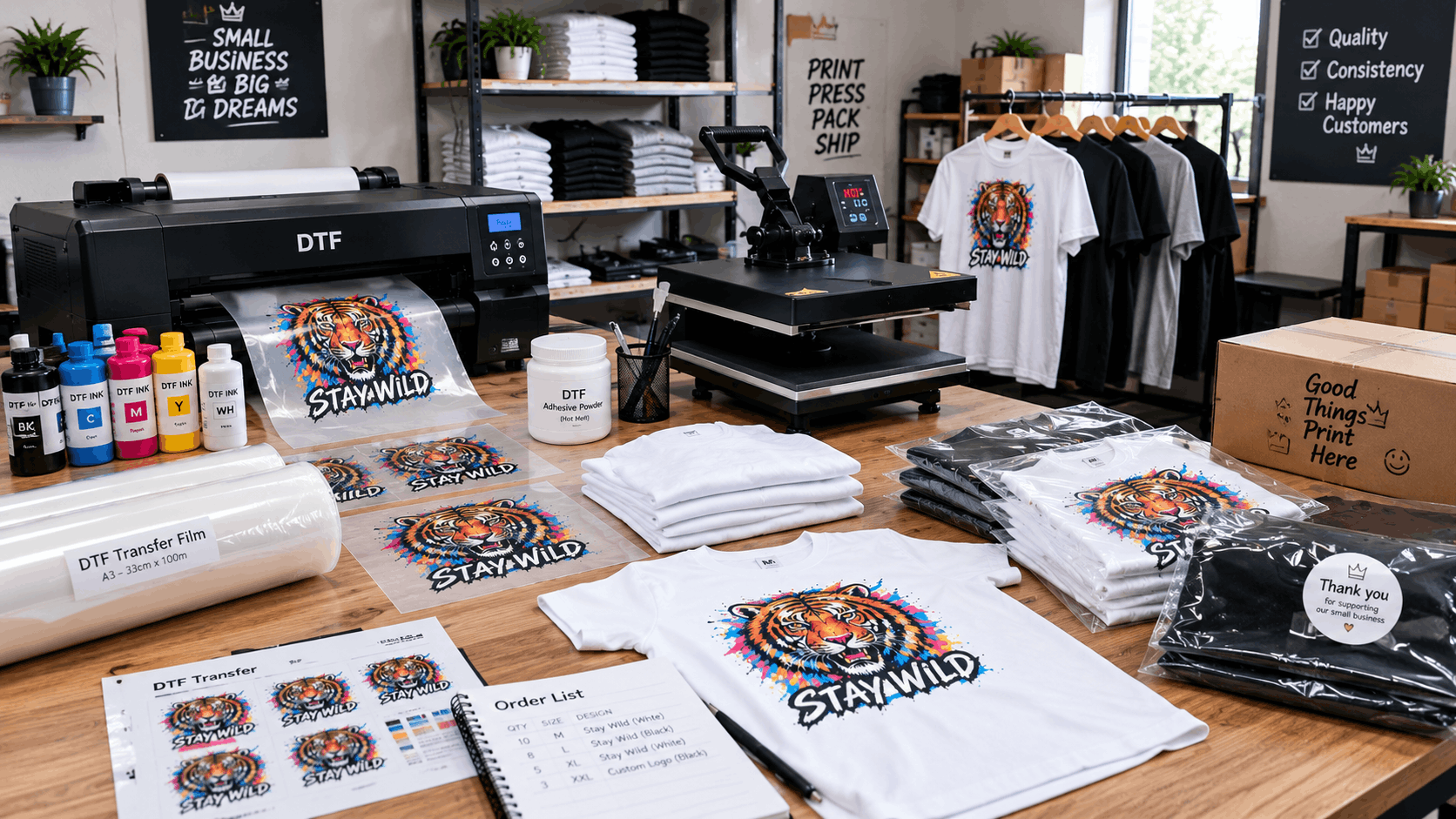
For a small T-shirt business, deciding whether to buy a DTF printer or outsource transfers can affect costs, production speed, workspace, and daily workflow. Both options can work well, but the right choice depends on how many orders you handle, how much control you need, and how ready your business is to manage printing equipment.
Outsourcing lets you purchase ready-to-press DTF transfers from a supplier. Buying a printer brings the printing process in-house, giving you more control but also adding equipment, consumables, maintenance, and operational responsibilities.
What Does Outsourcing DTF Transfers Mean?
When you outsource DTF transfers, another printing company produces the artwork onto DTF film and sends the finished transfers to your business.
You then use a heat press to apply those transfers to blank T-shirts, hoodies, tote bags, or other compatible products.
This approach can be useful for businesses that are still testing demand. Instead of investing in a printer and its supporting equipment immediately, you can concentrate on selling products, creating designs, handling customers, and fulfilling orders.
The main trade-off is that you depend on an outside supplier for production time, transfer quality, availability, and pricing.
What Changes When You Buy a DTF Printer?
Buying a DTF printer moves an important part of the production process into your own workspace.
You can print transfers according to your own schedule and adjust production around customer orders. However, a printer is not the only piece of equipment involved.
A practical DTF workflow may require:
- DTF printer
- DTF film
- CMYK and white DTF ink
- Adhesive powder
- Powder application and curing equipment
- Heat press
- RIP or printer software
- Cleaning supplies
- Proper workspace and ventilation considerations
- Regular maintenance
This means the purchase decision should be based on the complete workflow rather than the printer price alone.
When Outsourcing May Make More Sense
Outsourcing can be practical when your T-shirt business has relatively low or unpredictable transfer requirements.
For example, imagine a new business receiving only a few custom orders each week. Buying equipment immediately could leave the owner responsible for maintenance and supplies even when the printer is not being used frequently.
Outsourcing can also be useful when:
You are still testing the market
If you are unsure which designs, products, or customer groups will generate consistent sales, outsourcing allows you to start with less equipment.
Your workspace is limited
A home-based business may not have enough room for a printer, curing setup, heat press, supplies, and storage.
You want a simpler workflow
Outsourcing reduces the number of production tasks you need to manage yourself. You can focus more on design, marketing, customer service, and fulfillment.
When Buying a DTF Printer May Be Worth Considering
A printer can become more attractive as your order volume and production requirements increase.
If you regularly purchase transfers and have enough demand to keep equipment productive, bringing printing in-house may provide greater control over your workflow.
Businesses may consider purchasing a printer when they need:
- Faster control over production schedules
- More flexibility for custom orders
- Greater control over print quantities
- In-house testing of designs
- Reduced dependence on transfer suppliers
- A production process that can grow with the business
Before purchasing, however, calculate the total cost of operating the setup rather than comparing only the transfer price with the printer’s purchase price.
Compare the Total Cost, Not Just the Printer Price
A simple comparison can help.
With outsourcing, your expenses may include:
Transfer cost + shipping + blank garment + heat pressing + packaging
With in-house printing, the calculation can include:
Ink + film + powder + printer maintenance + curing + electricity + labor + equipment cost + blank garment + heat pressing + packaging
The exact numbers vary by printer, supplier, design size, production volume, and local operating costs.
This is why a small business should estimate its expected monthly transfer usage before making a purchase.
For businesses researching equipment, a small-business DTF printer guide can also help organize the main factors to consider, including printer size, production requirements, maintenance, and overall workflow.
What About Maintenance?
Maintenance is one of the biggest differences between buying and outsourcing.
When you outsource transfers, the supplier handles the printing equipment. Your responsibilities generally begin when the transfer arrives.
With an in-house printer, the business owner must understand routine maintenance. DTF printers use white ink, which requires particular attention because poor maintenance can affect print quality and reliability.
Regular checks, cleaning procedures, proper ink handling, and following the equipment manufacturer’s maintenance instructions should become part of the production routine.
A business that does not have time to maintain its equipment may find outsourcing more convenient, even if in-house printing appears attractive from a production perspective.
Think About Your Future Order Volume
The decision should also consider where the business is heading.
A business with very low order volume may prefer outsourcing while building its customer base. A growing apparel business with increasingly regular orders may eventually need more control over production.
Instead of asking only, “Is buying a DTF printer cheaper?” ask:
How many transfers do I expect to need each month, how much control do I require, and can I manage the complete printing workflow?
Those questions provide a more useful basis for the decision.
Buying vs Outsourcing: A Simple Comparison
| Factor | Buy a DTF Printer | Outsource Transfers |
|---|---|---|
| Initial investment | Higher | Lower |
| Production control | High | Dependent on supplier |
| Maintenance | Required | Handled by supplier |
| Workspace needed | More | Less |
| Custom production timing | Flexible | Depends on supplier |
| Equipment knowledge | Required | Minimal |
| Scalability | Can support in-house growth | Depends on supplier capacity |
| Operational responsibility | Higher | Lower |
Neither option automatically fits every small T-shirt business. The better approach is to match the production method with current demand, available space, budget, and the owner’s willingness to manage printing equipment.
A Practical Decision Checklist
Before purchasing a DTF printer, consider these questions:
- How many transfers do I currently order each month?
- Is my order volume consistent or unpredictable?
- How much workspace do I have?
- Can I manage regular printer maintenance?
- Do I need faster control over custom orders?
- Have I calculated ink, film, powder, electricity, and maintenance costs?
- Do I already have a suitable heat press?
- Am I prepared to learn the complete DTF workflow?
- Do I expect my apparel business to expand?
- Would outsourcing allow me to focus more effectively on sales and customer acquisition?
The answers can make the decision much clearer.
Final Considerations
For a new or low-volume T-shirt business, outsourcing DTF transfers can reduce equipment responsibilities while the business establishes its products and customer base. For a business with consistent demand, sufficient workspace, and a need for greater production control, bringing DTF printing in-house may become a more practical option.
The key is to evaluate the entire production system rather than looking at the printer price alone. Order volume, operating costs, maintenance, workspace, turnaround requirements, and future growth should all be considered before committing to either approach.

